
Bitcoin vs ETFs for Retirement
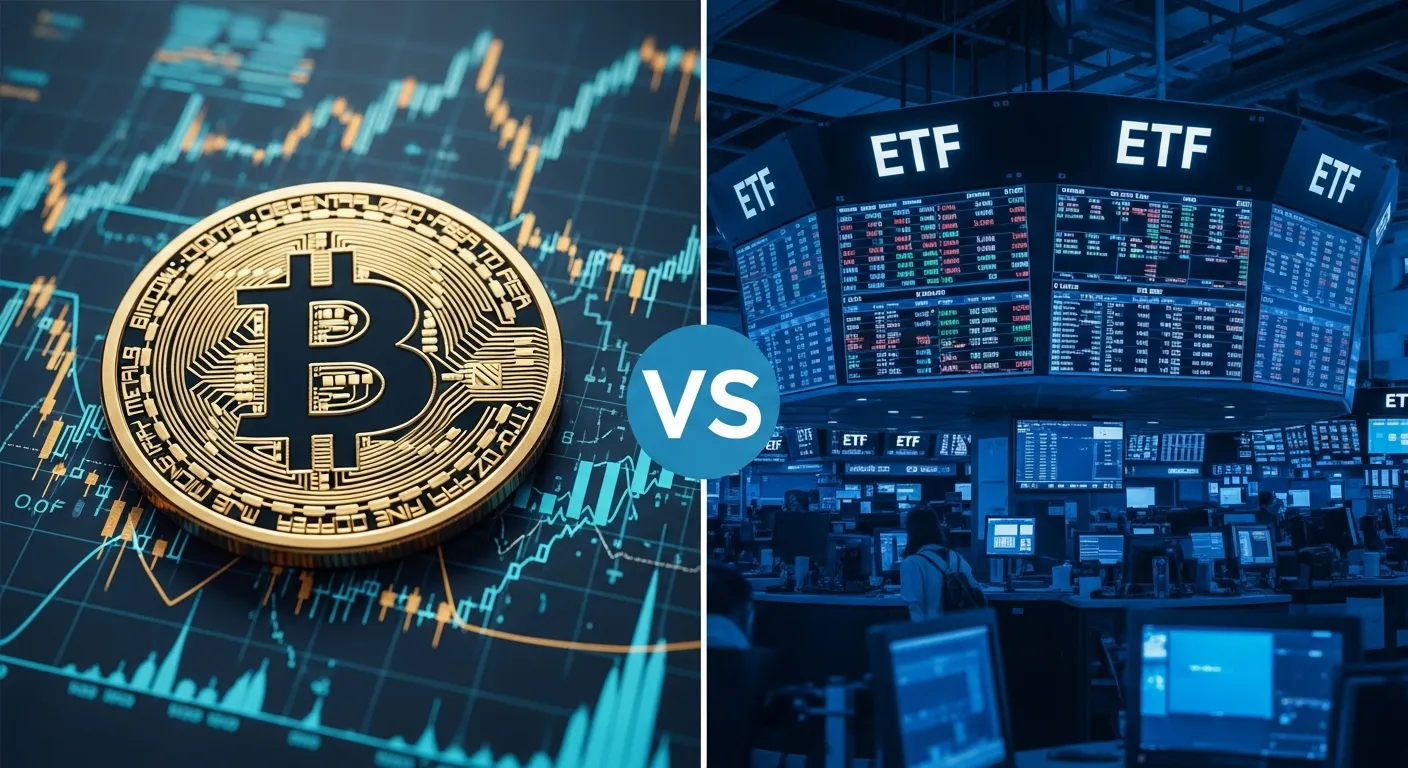
When it comes to building a retirement portfolio, most people think of index fund ETFs — and for good reason. ETFs like the S&P 500 have delivered consistent returns for decades. But Bitcoin has entered the conversation as a serious alternative, outperforming every traditional asset class over the past 15 years.
So which is better for retirement: Bitcoin or ETFs? The honest answer is that both have a role to play — but understanding their differences is crucial for making an informed decision. Let's compare them head-to-head.
👉 Calculate your Bitcoin retirement timeline now — it only takes 30 seconds! (free)
Historical Returns: Bitcoin vs S&P 500
Let's start with the numbers everyone cares about — returns.
S&P 500 ETF (e.g., VOO, SPY)
- Average annual return (1928–2025): ~10% (nominal), ~7% (inflation-adjusted)
- Best year (2013): +32.4%
- Worst year (2008): -37%
- 10-year CAGR (2016–2025): ~12%
Bitcoin
- Average annual return (2011–2025): ~150%+ (though declining over time)
- Best year (2013): +5,500%
- Worst year (2022): -65%
- 10-year CAGR (2016–2025): ~70%
Even accounting for Bitcoin's extreme volatility, its long-term returns dwarf those of the stock market. An investor who put $1,000 into Bitcoin in 2015 would have over $200,000 today. The same $1,000 in the S&P 500 would be worth roughly $3,500.
However, past performance doesn't guarantee future results — especially as Bitcoin matures and growth rates naturally decelerate.
Risk Profile: Volatility Comparison
ETFs
- Maximum drawdown (S&P 500): ~55% (2007–2009 financial crisis)
- Typical annual volatility: 15–20%
- Recovery time from worst crash: ~5.5 years
- Frequency of 20%+ drops: Roughly once per decade
Bitcoin
- Maximum drawdown: ~85% (2017–2018 and 2021–2022 cycles)
- Typical annual volatility: 50–80%
- Recovery time from worst crash: ~2–3 years
- Frequency of 50%+ drops: Roughly once per cycle (every 4 years)
Bitcoin is significantly more volatile than ETFs. However, there's an important nuance: Bitcoin has always recovered from its crashes and gone on to new all-time highs — something even the S&P 500 can claim, but with much longer recovery times relative to the depth of the drop.
For retirement planning, this means: if your time horizon is 10+ years, Bitcoin's volatility is less of a concern. If you need the money within 2–3 years, ETFs are the safer choice.
Custody: Who Controls Your Money?
This is where Bitcoin and ETFs differ fundamentally.
ETFs
- Custody: Held by a brokerage (Fidelity, Schwab, Vanguard, etc.)
- Your control: You own shares, but the brokerage holds them. If the brokerage fails, SIPC insurance covers up to $500,000
- Risks: Counterparty risk, brokerage insolvency, government freezes, regulatory changes
- Access: Trading hours only (weekdays, market hours)
Bitcoin (Self-Custody)
- Custody: You hold the private keys directly (hardware wallet, seed phrase)
- Your control: Full ownership. No intermediary can freeze, seize, or restrict access
- Risks: Loss of seed phrase = permanent loss of funds. No insurance, no recovery
- Access: 24/7/365, anywhere in the world
Bitcoin's self-custody is both its greatest strength and its greatest responsibility. You are your own bank — which means no one can take your retirement from you, but you must take security seriously.
For those uncomfortable with self-custody, Bitcoin ETFs (like the spot Bitcoin ETFs approved in 2024) offer a middle ground: Bitcoin exposure with traditional brokerage custody.
Inflation Protection
ETFs
The S&P 500 provides indirect inflation protection because corporate earnings tend to rise with inflation. However, in periods of high inflation (like 2022), stock returns can lag behind price increases, eroding real purchasing power.
Bitcoin
Bitcoin has a hard cap of 21 million coins — no central bank can print more. This programmatic scarcity makes it a potential hedge against monetary inflation. While Bitcoin's short-term price doesn't always correlate inversely with inflation, its long-term trajectory suggests it preserves and grows purchasing power far better than fiat currencies.
Verdict: Bitcoin offers stronger structural inflation protection due to its fixed supply. ETFs provide partial protection through corporate earnings growth.
Tax Implications
ETFs
- Dividends taxed annually (even if reinvested)
- Capital gains tax on sale
- Tax-advantaged accounts available (401k, IRA, Roth IRA)
- Relatively simple tax reporting
Bitcoin
- No dividends = no annual tax burden while holding
- Capital gains tax on sale (short-term vs long-term rates apply)
- Bitcoin IRAs available but with higher fees
- Tax reporting can be complex with multiple transactions
Key advantage of Bitcoin: You pay zero taxes while HODLing. With ETFs, dividend distributions create annual tax events even if you don't sell.
Correlation and Diversification
One of the strongest arguments for including both Bitcoin and ETFs in a retirement portfolio is their low correlation. Bitcoin often moves independently of stock markets, which means:
- When stocks crash, Bitcoin may hold value (or vice versa)
- A portfolio containing both assets has lower overall volatility than either alone
- Rebalancing between the two can capture gains from whichever asset outperforms
Studies have shown that adding even a 5–10% Bitcoin allocation to a traditional 60/40 stock/bond portfolio significantly improves risk-adjusted returns over 5+ year periods.
The Retirement Portfolio Comparison
Let's model two hypothetical retirement portfolios over 10 years (starting with $50,000 and adding $500/month):
Portfolio A: 100% S&P 500 ETF (10% annual return)
- Value after 10 years: ~$230,000
- Annual retirement income (4% rule): ~$9,200
Portfolio B: 100% Bitcoin (Conservative 20% annual return)
- Value after 10 years: ~$590,000
- Annual retirement income (4% rule): ~$23,600
Portfolio C: 70% ETF + 30% Bitcoin (blended ~13% return)
- Value after 10 years: ~$320,000
- Annual retirement income (4% rule): ~$12,800
Even the conservative Bitcoin assumption dramatically outperforms a pure ETF portfolio. The blended approach offers a compelling middle ground for risk-conscious investors.
Which Should You Choose?
Choose ETFs if:
- You have a low risk tolerance
- Your retirement is less than 5 years away
- You prefer hands-off investing through traditional brokerages
- You want tax-advantaged accounts (401k/IRA)
Choose Bitcoin if:
- You have a 10+ year time horizon
- You value self-sovereignty and censorship resistance
- You believe in Bitcoin's long-term growth thesis
- You're comfortable with high volatility
Choose Both if:
- You want the best risk-adjusted returns
- You understand diversification benefits
- You want inflation protection + growth potential
- You're willing to learn proper Bitcoin custody
Calculate Your Bitcoin Retirement Timeline
Whatever allocation you choose, knowing when you could reach financial freedom is the first step. Our calculator lets you model different scenarios with Bitcoin's prediction models.
Try the WenMoon Bitcoin Retirement Calculator — enter your current holdings and monthly savings to see when Bitcoin could make you financially free. It's free and takes 30 seconds.
Important Disclaimer
This article is for educational and entertainment purposes only and does not constitute financial advice. Both Bitcoin and ETFs carry risks, and past performance does not guarantee future results. Bitcoin is extremely volatile and may lose significant value. Always consult a qualified financial advisor before making retirement planning decisions. Diversification does not guarantee profits or protect against losses.
Related Articles
Bitcoin Basics: What Is BTC & How It Works
A comprehensive guide for beginners about the fundamentals of Bitcoin, blockchain technology, and decentralized currencies.

Bitcoin Retirement Planning: A Step-by-Step Guide
A practical, step-by-step guide to planning your retirement with Bitcoin. From setting your target number to building a savings plan and managing risks — everything you need to get started.

Bitcoin Investment Strategies
Discover various Bitcoin investment strategies for different risk profiles and investment goals.