
Bitcoin for Millennials & Gen Z
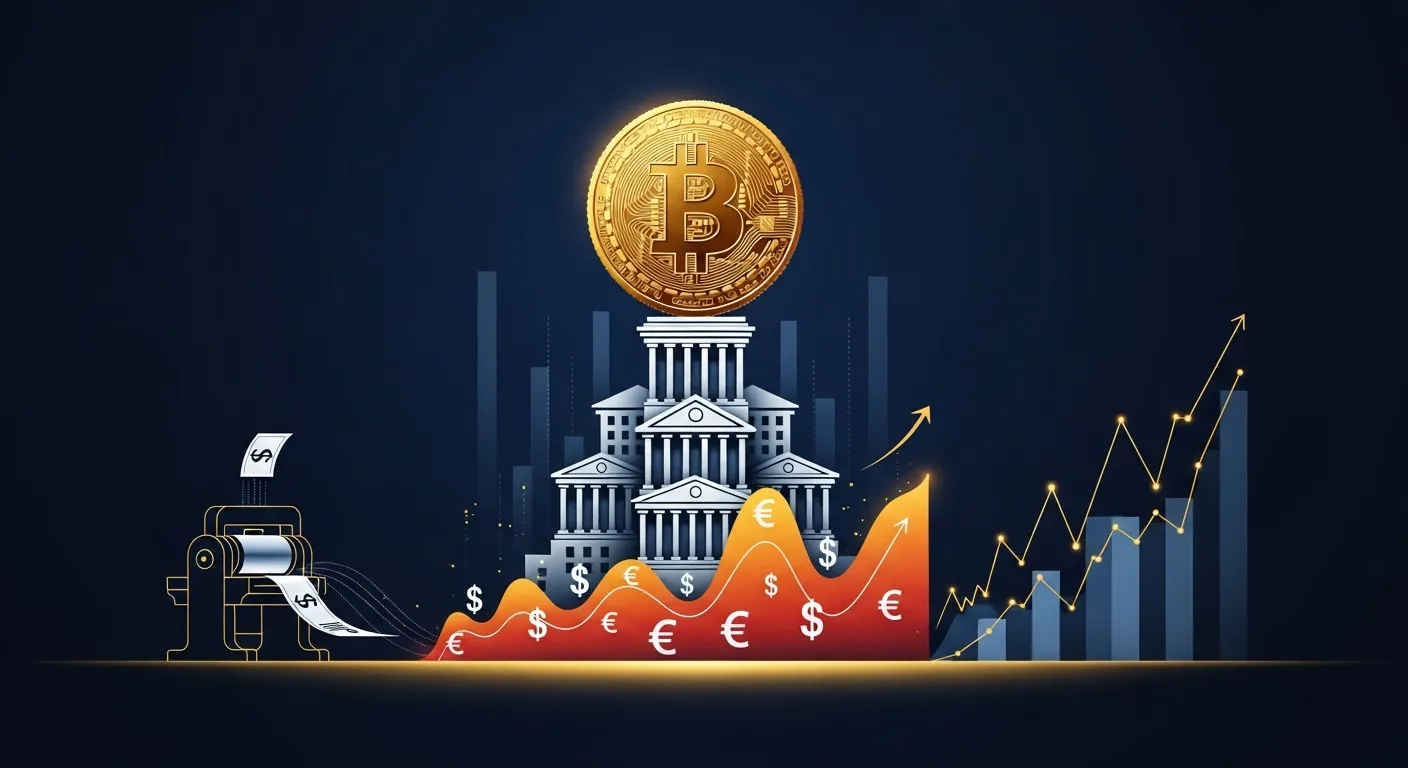
Why Traditional Finance Is Failing Young People
If you're a Millennial (born 1981–1996) or Gen Z (born 1997–2012), you've inherited a financial system that wasn't designed for you. The numbers are blunt:
- Housing costs rose 118% since 2000 — wages grew only 54%
- Student loan debt in the US exceeds $1.7 trillion
- Real savings rates (adjusted for inflation) are at historic lows
- Social Security is projected to be insolvent by 2034 without reform
- Traditional pensions have been largely replaced by underfunded 401(k)s
The path that worked for Boomers — degree, house, 401(k), retire at 65 — is mathematically broken for younger generations. Housing is unaffordable. Degrees no longer guarantee jobs. Inflation is quietly eroding savings accounts.
This is where Bitcoin enters the picture. Not as a speculative gamble, but as a fundamentally different approach to building wealth — one that younger generations can access from day one, with any amount.
Why Bitcoin Is Uniquely Suited for Younger Investors
Time Is Your Superpower
The single most powerful variable in wealth building isn't how much you invest — it's how long you invest. And younger people have the most time.
Bitcoin's historical CAGR (Compound Annual Growth Rate):
| Period | CAGR |
|---|---|
| 2011–2026 (15 years) | ~110% |
| 2015–2026 (11 years) | ~75% |
| 2017–2026 (9 years) | ~63% |
| 2020–2026 (6 years) | ~55% |
Even if Bitcoin's growth rate slows dramatically to 25–30% annually (less than half the historical rate), the compounding effect over 15–20 years is extraordinary.
Example: $200/month starting at age 25, with 25% annual growth:
| Age | Total Invested | Portfolio Value |
|---|---|---|
| 30 | $12,000 | $21,600 |
| 35 | $24,000 | $82,500 |
| 40 | $36,000 | $265,000 |
| 45 | $48,000 | $830,000 |
| 50 | $60,000 | $2,560,000 |
At even half this growth rate (12.5%), the same $200/month would grow to $285,000 by age 50 — still a 4.7x return on invested capital.
Digital Natives Understand Digital Money
Millennials and Gen Z are the first generations to grow up fully digital. For you, the concept of digital scarcity isn't abstract — it's intuitive:
- You've traded virtual items in games (Fortnite skins, CS:GO knives)
- You understand that digital art can have value (NFTs, whether you like them or not)
- You've used digital payment apps (Venmo, Cash App, Zelle) more than physical cash
- You trust technology-first solutions more than institutional ones
Bitcoin isn't "magic internet money" to your generation — it's the logical next step in the digitization of value.
Distrust of Traditional Institutions
Surveys consistently show that younger generations have less trust in traditional financial institutions:
| Trust Metric | Boomers | Gen X | Millennials | Gen Z |
|---|---|---|---|---|
| Trust in banks | 62% | 48% | 37% | 29% |
| Trust in government pensions | 54% | 38% | 22% | 16% |
| Trust in stock market fairness | 51% | 41% | 31% | 25% |
| Trust in cryptocurrency | 12% | 18% | 38% | 44% |
This isn't irrational cynicism. It's an evidence-based response to 2008's financial crisis, repeated quantitative easing, persistent inflation, and institutional failures. Bitcoin's trustless, decentralized design directly addresses these concerns — there is no board of directors to bail out, no central bank to devalue your holdings.
The FIRE Movement Meets Bitcoin
What Is FIRE?
FIRE (Financial Independence, Retire Early) is a movement focused on aggressive saving and investing to achieve financial independence decades before traditional retirement age. The core principle: once your investment portfolio reaches 25x your annual expenses (the "4% rule"), you can live off investment returns indefinitely.
Why Bitcoin Supercharges FIRE
Traditional FIRE strategies rely on index funds returning 7–10% annually. With Bitcoin's potential for 20–30% annual returns (conservatively), the timeline to FIRE compresses dramatically:
Time to reach $1,000,000 portfolio (starting from $0, saving $500/month):
| Asset | Annual Return | Years to $1M |
|---|---|---|
| S&P 500 Index Fund | 10% | ~25 years |
| Mixed Portfolio (70/30 stocks/BTC) | 15% | ~19 years |
| Bitcoin-heavy Portfolio (50/50) | 20% | ~15 years |
| Primarily Bitcoin (80/20 BTC/stocks) | 25% | ~13 years |
Critical caveat: Higher returns come with higher volatility. Bitcoin can drop 50–80% in bear markets. The key is time horizon — over any 4+ year period in Bitcoin's history, investors have always been profitable.
The "Bitcoin FIRE Number"
Your FIRE number depends on your annual expenses and your expected portfolio growth rate:
| Monthly Expenses | Annual Expenses | FIRE Number (25x) | BTC Needed (at $1M/BTC) | BTC Needed (at $3M/BTC) |
|---|---|---|---|---|
| $2,000 | $24,000 | $600,000 | 0.60 BTC | 0.20 BTC |
| $3,000 | $36,000 | $900,000 | 0.90 BTC | 0.30 BTC |
| $4,000 | $48,000 | $1,200,000 | 1.20 BTC | 0.40 BTC |
| $5,000 | $60,000 | $1,500,000 | 1.50 BTC | 0.50 BTC |
According to the Power Law model, Bitcoin could reach $1–3M by 2035–2040. A 25-year-old investing today could reach financial independence by their early 40s with even modest Bitcoin allocation.
Use our Bitcoin Retirement Calculator to run your personal scenarios.
Practical Strategy: How to Start Building
Step 1: Set Up Dollar-Cost Averaging (DCA)
DCA means investing a fixed amount at regular intervals, regardless of price. It's the most stress-free and statistically effective strategy for building a Bitcoin position:
Why DCA works:
- Eliminates the need to "time the market" (which even professionals fail at)
- Smooths out volatility — you buy more when prices are low, less when they're high
- Builds discipline and habit
- Removes emotional decision-making
Recommended platforms by region:
| Region | Platform | Min. Investment | Fees | DCA Feature |
|---|---|---|---|---|
| USA | Swan Bitcoin | $10/week | 1.49% | Yes (automated) |
| USA | Cash App | $1 | 1.5–2.5% | Yes |
| Europe | Relai | €10 | 1.5% | Yes (automated) |
| Europe | Pocket Bitcoin | €10 | 1.5% | Yes |
| UK | CoinCorner | £10 | ~1% | Yes |
| Global | Strike | $1 | ~0.99% | Yes |
Learn more about Bitcoin savings plans and why they outperform lump-sum investing in volatile markets.
Step 2: Choose Your Allocation
How much of your portfolio should be in Bitcoin? This depends on your risk tolerance, time horizon, and financial situation:
| Profile | Bitcoin Allocation | Traditional Assets | Risk Level | Best For |
|---|---|---|---|---|
| Conservative | 5–10% | 90–95% | Low | Risk-averse, shorter timeline |
| Moderate | 15–25% | 75–85% | Medium | Balanced, 10+ year horizon |
| Aggressive | 30–50% | 50–70% | High | FIRE-focused, 15+ year horizon |
| Bitcoin-first | 50–80% | 20–50% | Very High | Maximum conviction, 20+ year horizon |
Key principle: Only invest what you can afford to lose without affecting your daily life. Bitcoin is volatile in the short term, even if it's been the best-performing asset over any long-term period.
Step 3: Secure Your Holdings
As your Bitcoin position grows, security becomes increasingly important:
Under $1,000: A reputable exchange or mobile wallet is fine $1,000–$10,000: Consider a hardware wallet (Ledger, Trezor, BitBox) $10,000+: Hardware wallet is essential; consider multi-signature setup $100,000+: Multi-signature wallet, geographic distribution, inheritance planning
Read our complete guide to Bitcoin security for detailed recommendations.
Step 4: Optimize for Taxes
Tax optimization can significantly impact your long-term returns:
United States:
- Long-term capital gains (held 1+ year): 0–20% depending on income
- Consider Roth IRA contributions (tax-free growth) if eligible
- Tax-loss harvesting in bear markets to offset gains
- No wash sale rule for crypto (as of 2026) — you can sell at a loss and immediately rebuy
United Kingdom:
- Capital Gains Tax allowance: £6,000/year (2024/25)
- Consider ISA-wrapped Bitcoin products when available
- Holding period doesn't affect tax rate
Europe (varies by country):
- Germany: Tax-free after 1 year holding — one of the best jurisdictions globally
- Portugal: Generally tax-free for individual investors
- Switzerland: No capital gains tax for private holdings
Read more about Bitcoin and taxes for detailed country-specific guidance.
Common Objections (And Why They're Wrong)
"I'm too late — Bitcoin has already gone up too much"
This is the most common objection, and it's been wrong at every price point in Bitcoin's history. People said this at $100, $1,000, $10,000, and $50,000. Each time, those who invested anyway and held long-term were handsomely rewarded.
The math: Bitcoin's current market cap is ~$1.8 trillion. Gold is ~$15 trillion. Global real estate is ~$330 trillion. Bitcoin capturing even a small fraction of these markets implies prices of $1 million+.
"It's too volatile — I could lose everything"
Bitcoin is volatile in the short term but has been the best-performing asset over any 4+ year period. The key is time horizon:
| Holding Period | Chance of Profit (historically) |
|---|---|
| 1 day | ~53% |
| 1 month | ~60% |
| 1 year | ~75% |
| 2 years | ~87% |
| 4 years | ~100% |
If you have a 10–20 year horizon (as most Millennials and Gen Z do for retirement), short-term volatility is irrelevant.
"I can't afford to invest"
You don't need to buy a whole Bitcoin. With most platforms, you can start with as little as $1. Even $25/week ($100/month) can build a meaningful position over time:
| Monthly Investment | After 10 Years (at 25% CAGR) | After 20 Years |
|---|---|---|
| $50 | $33,000 | $540,000 |
| $100 | $66,000 | $1,080,000 |
| $200 | $132,000 | $2,160,000 |
| $500 | $330,000 | $5,400,000 |
"It uses too much energy"
This is a common misconception. Bitcoin mining increasingly uses renewable energy (estimated 52–59% as of 2024) and often utilizes stranded energy that would otherwise be wasted (methane flaring, excess hydroelectric, etc.). Bitcoin mining incentivizes renewable energy development and grid stabilization.
The Mental Model: Bitcoin as Digital Property
The best way to think about Bitcoin as a young person is as digital property — similar to buying real estate, but with key advantages:
| Attribute | Real Estate | Bitcoin |
|---|---|---|
| Minimum investment | $50,000–100,000+ (down payment) | $1 |
| Liquidity | Low (months to sell) | High (sell in minutes, 24/7) |
| Maintenance costs | Taxes, repairs, insurance | None |
| Geographic limitation | Fixed location | Global, portable |
| Supply | Increasing (new construction) | Fixed (21 million, ever) |
| Divisibility | Difficult | Infinitely divisible |
| Accessibility | Requires credit, income proof | Anyone with internet |
| Historical appreciation | ~4% per year | ~50%+ per year |
Real estate has created more millionaires than any other asset class in history. Bitcoin has the potential to do the same — but accessible to everyone, not just those with existing wealth and credit.
Your Generation's Unique Opportunity
Here's the truth that most financial advisors won't tell you: Millennials and Gen Z are living through the most significant monetary transformation in centuries. Bitcoin is transitioning from a niche technology to a global reserve asset, and this transition will create an unprecedented wealth transfer.
Those who understand this and act — even with small, consistent investments — will find themselves on the right side of history. Those who dismiss it will look back with the same regret as people who could have bought Apple stock in 2003 or Amazon in 2001.
The difference? You don't need to pick the right stock. There's only one Bitcoin, and it's designed to become more valuable over time as adoption grows and supply shrinks.
Frequently Asked Questions (FAQ)
How much Bitcoin should a 25-year-old own?
There's no single right answer, but most financial advisors who understand Bitcoin recommend 5–20% of your investment portfolio for younger investors. Given a 20+ year time horizon, even a small allocation can grow significantly. The key is consistency — start a DCA plan and stick with it.
Is Bitcoin better than a 401(k)?
They serve different purposes and aren't mutually exclusive. A 401(k) with employer matching is essentially free money — always take the match first. Beyond the match, Bitcoin's potential returns and tax advantages (especially in favorable jurisdictions) make it an excellent complement or alternative for additional savings.
When should I sell my Bitcoin?
For retirement-focused investors, the answer is: when you need the income. This could be decades from now. The 4% rule suggests withdrawing 4% of your portfolio annually once you reach financial independence. With Bitcoin, you might use the Lightning Network to spend directly rather than selling.
What if Bitcoin goes to zero?
While theoretically possible, Bitcoin going to zero would require every user, miner, developer, institution, and government that holds or uses Bitcoin to simultaneously abandon it. After 15+ years, with $1.8 trillion in market cap, Bitcoin ETFs, and increasing sovereign adoption, this scenario is extraordinarily unlikely.
Should I tell my parents about Bitcoin?
Focus on your own financial education first. If your parents are open-minded, share resources and let them draw their own conclusions. Many Millennials and Gen Z members report that their parents became interested after seeing real portfolio growth over 2–3 years.
Conclusion: The Time to Start Is Now
The financial system that served previous generations is breaking down. Housing is unaffordable, pensions are disappearing, and inflation is eroding savings. But for the first time in history, there's an alternative: a digital, scarce, decentralized asset that anyone can own and that has outperformed every traditional investment over every meaningful time period.
Your Action Plan
- Calculate your FIRE number: Use our Bitcoin Retirement Calculator to see exactly when you could achieve financial independence
- Start small: Set up a DCA plan for $25–$100/week on a reputable platform
- Educate yourself: Read about the Power Law model, Bitcoin basics, and investment strategies
- Secure your holdings: As your position grows, move to a hardware wallet
- Stay patient: Bitcoin rewards long-term holders. The biggest gains come to those who buy and hold through cycles
- Think in decades: You're not trading — you're building generational wealth
You don't need to be rich to start. You don't need to understand blockchain technology. You just need to start — and time will do the rest.
The best time to plant a tree was 20 years ago. The second best time is today.
Disclaimer: This article is for educational and informational purposes only. This is not financial advice. Only invest money you can afford to lose. Past performance does not guarantee future results.
Related Articles

Bitcoin Savings Plan: DCA Strategy
Learn how you can build long-term wealth with a Bitcoin savings plan through regular investments.

Bitcoin Retirement Planning: A Step-by-Step Guide
A practical, step-by-step guide to planning your retirement with Bitcoin. From setting your target number to building a savings plan and managing risks — everything you need to get started.

Bitcoin Investment Strategies
Discover various Bitcoin investment strategies for different risk profiles and investment goals.